
In the first two articles of this series, we considered the Elara 900 through two closely connected lenses: visualization and ergonomics.
In modern ophthalmology, however, seeing more and feeling better are only part of the story. Clinics are under pressure, patient volumes are high, appointment schedules are dense, and routine examinations often need to be completed with both speed and precision.
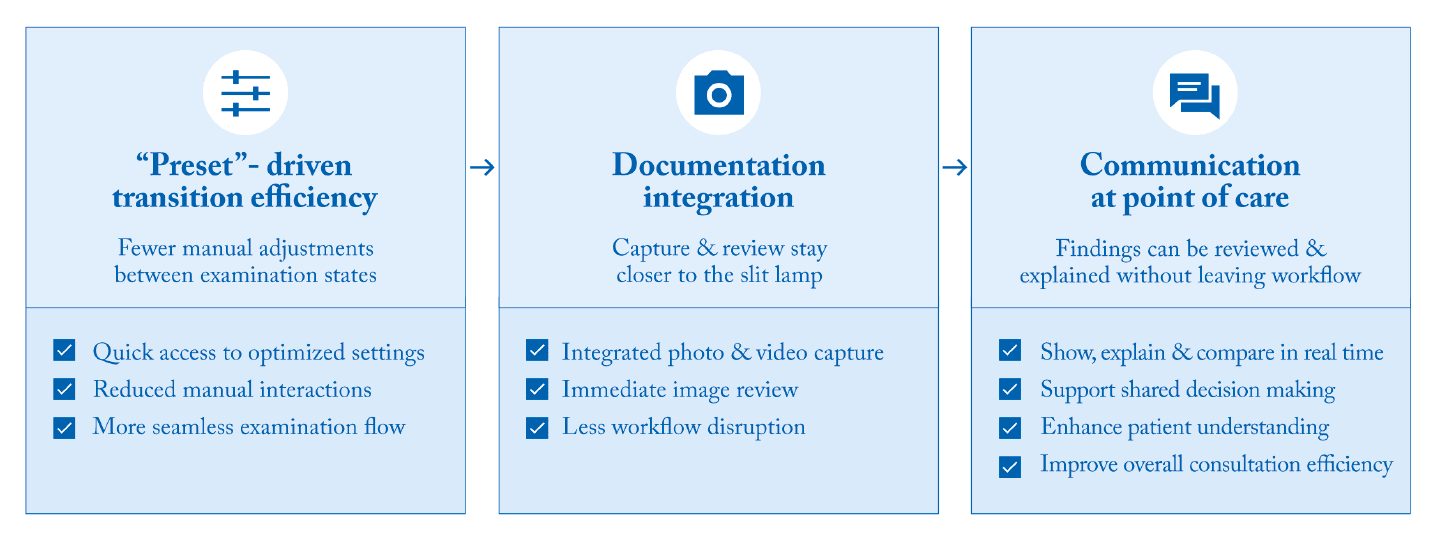
That’s why the third part of this series focuses on efficiency – not just in terms of speed, but as a more integrated examination concept. With the Elara 900, Haag-Streit has sought to reduce repeated manual interactions, streamline transitions between examination steps, and bring documentation more naturally into the clinical workflow.
The burden of manual workflow
Conventional slit lamp microscopy is an indispensable clinical modality, but it remains highly manual. During a single examination, clinicians may repeatedly adjust slit width, slit height, slit axis, magnification, illumination intensity, filters, working height, and documentation tools. Over the course of a full clinic day, these manual actions become part of a familiar rhythm: adjust, observe, readjust, document, repeat.
The Elara 900 efficiency white paper illustrates this practical workflow burden. Traditional examinations require clinicians to rebuild each examination state manually. Moving from a broad overview to a narrow slit; from surface assessment to anterior chamber evaluation, from fundus viewing to fluorescein or tonometry, often involves a sequence of separate mechanical changes.
The Elara 900 was developed to address this challenge through a combination of technologies: motorized magnification change, yellow-filter activation, height adjustment, as well as integrated image and video capture, and, crucially, predefined examination steps known as “presets.” “Presets” are enabled through Elara 900’s revolutionary “P-Type” projector based illumination system, in which individual pixels form the slit geometry. Every pixel can be controlled, allowing forms and colors to be changed in a split second.
These technologies are designed to work together. Elara 900’s digital “presets” reduce the time spent adjusting filters, modifying slit width, changing illumination intensity, or moving between magnification levels. Automated examination scenarios allow clinicians to apply optimized settings at the touch of a “preset” button or with a scroll of the “preset” wheel.

“Preset”-driven examination
One of the clearest differences between a traditional slit lamp and the Elara 900 lies in how clinicians move through the examination sequence. In a conventional workflow, each stage may require several manual changes: illumination, slit geometry, magnification, filters, and sometimes device height.
The white paper describes this as a shift from a dynamic, manually reconstructed examination to a “preset”-driven workflow. For William G. Gensheimer, MD, ophthalmologist at Dartmouth Health, USA, this shift is particularly useful in high-volume clinical scenarios.
“I found that on my high-throughput exams – for instance, a day one cataract post-op – it was nice having the ‘presets,’” he says. “I start my exam with a broad-beam illumination and then narrow it to a slit… and then look in the anterior chamber on a high magnification with bright light… automating that does save you time on each exam, and makes you more efficient.”
William G. Gensheimer, MD adds, “If I had to describe the Elara 900 in one word, I would say: precision. It has the precision optics that we’re used to, but now you can more precisely perform your exam with the ‘preset’ mode.”
The efficiency message around Elara 900 is not “faster at any cost,” but rather: more precision with less effort.
Measurable efficiency gains
To evaluate whether this workflow concept translated into measurable benefit, Haag-Streit compiled pre-launch pilot-phase evaluations from multiple independent clinical sites.
The largest comparative examiner dataset came from the International Vision Correction Research Center at Heidelberg University Hospital, Germany, led by Gerd U. Auffarth, MD, PhD.
In this pilot-phase comparison:
20 questionnaires assessed time spent during routine examination with Elara 900 versus a conventional slit lamp
The mean standardized examination duration was 4.85 ± 0.96 minutes with the traditional BQ 900 slit lamp & 3.90 ± 1.12 minutes with Elara 900
Results correspond to an observed reduction of 0.95 minutes per examination, or 19.6 percent.
The white paper indicates that measurable efficiency gains may arise even when clinicians do not feel that the examination has become dramatically faster.
A workflow that adapts to the user
In a comparative examiner report by Filomena Ribeiro, MD, PhD - ophthalmologist at Hospital da Luz, Portugal - all 10 participants reported that Elara 900 “preset” usage had a positive effect on examination speed and workflow efficiency.
“The very first thing is how easy it is to adapt the slit lamp for different users,” says Filomena Ribeiro, MD, PhD. “Another thing that really impressed me was the ability to have a motorized magnification. With only a push, I can apply optimized settings that I have predefined and stay focused on the examination.”
This reflects a key part of the Elara 900 efficiency concept. “Presets” are not merely factory shortcuts; they can support customized examination routines. When a clinician’s preferred settings are stored and accessible, workflow efficiency becomes more personal and more clinically meaningful.
Faster, smoother, more complete
Gerd Auffarth, MD, PhD brings the contrast with conventional slit lamp use into focus. “If you use a conventional slit lamp, there’s a lot of hand work you have to do to get to the right heights, to the right angle, and you get into a certain routine with a conventional machine,” he says.
That familiar routine can be efficient in its own way, especially for experienced clinicians. But it is still built around repeated manual adjustment. The Elara 900 changes the interaction model by integrating electronic control, “preset”-driven settings, and easier documentation into the same workstation.
The Elara 900’s motorized height adjustment, for example, supports quick and precise repositioning with minimal manual effort. Its motorized magnification changer enables seamless magnification adjustments directly from the joystick, helping maintain an uninterrupted diagnostic experience. “Presets” allow multiple actions – including illumination color, slit width, filter activation, and magnification – to be summarized into a single operation. Together, these elements aim to accelerate clinical throughput while maintaining constant patient focus.

Documentation without disruption
Efficiency does not end when the eye has been examined. Increasingly, slit lamp findings need to be documented, reviewed, shared, and explained. The Elara 900 addresses this by seamlessly integrating image and video capture into the examination workflow itself. High-resolution images and videos can be captured directly from the device, supporting documentation and record-keeping. Captured content can be assigned to the correct patient file while working within the device, reducing the need for external manual data entry and complex system navigation.
Maria Kugelberg, MD, Professor of Ophthalmology at the Karolinska Institutet in Stockholm, Sweden, emphasizes the patient-facing value of this integrated imaging workflow. With Elara 900’s imaging “it’s very easy to show the patient what the problem is or how it looked last time because it’s saved in the system,” she says. “You can show patients in real time… just turn the screen and show them.”
Efficiency without compromise
As the data suggest, Elara 900 improves efficiency not through a single isolated feature, but through a more integrated examination concept. It allows examiners to move away from repeatedly reconstructing each examination state through a chain of manual changes. In practical terms, the result is accelerating workflow while preserving examination quality and patient interaction.
Read the full Efficiency white paper
