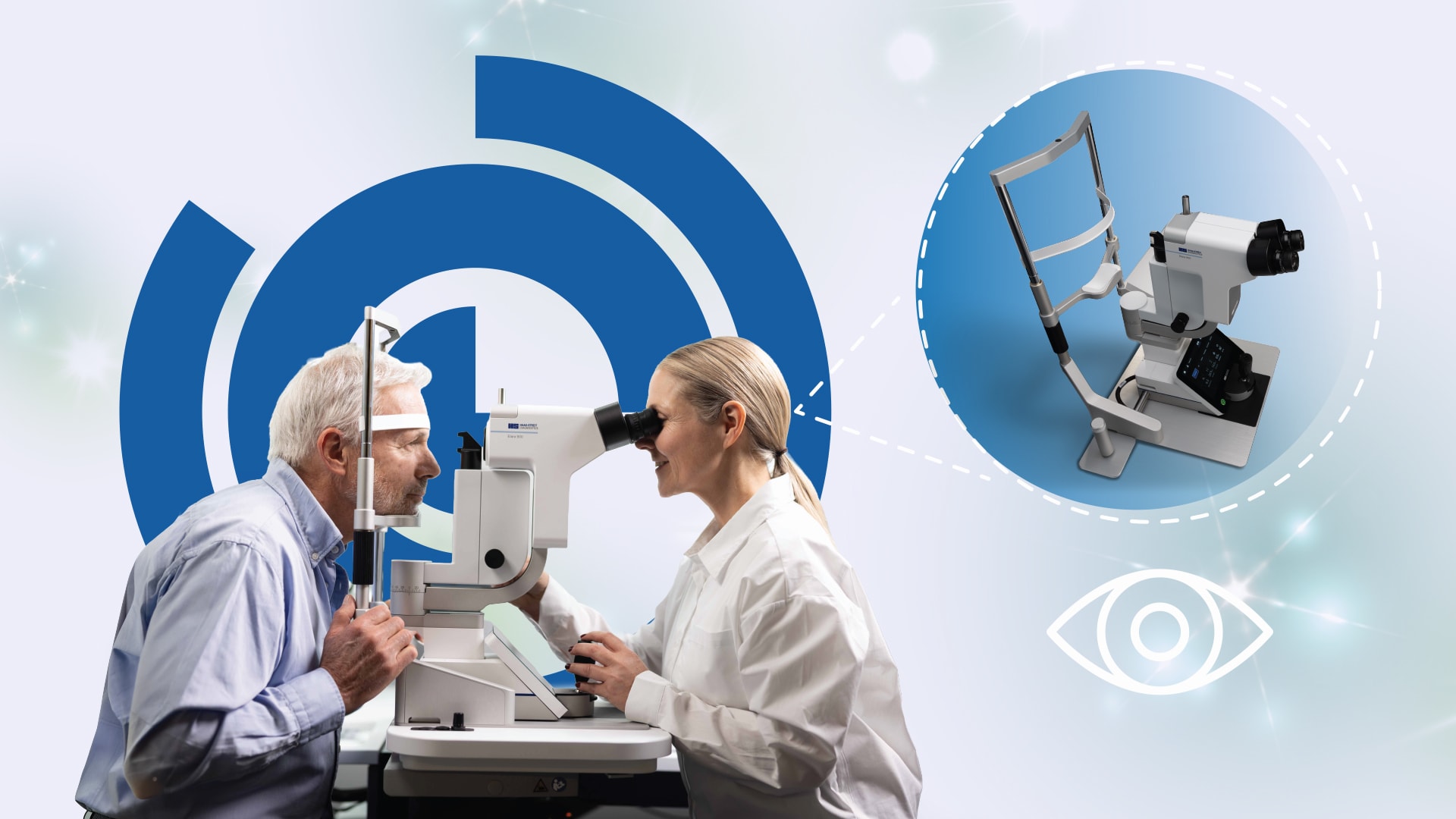
In the first article of this series – “Elara 900: Clarity in Focus” – we considered how the Haag-Streit Elara 900 is encouraging clinicians to rethink what clinical observation can mean in everyday practice with its projector-based “P-Type” illumination. But visualization is only one part of the examination experience. Slit lamp biomicroscopy is one of the most physically demanding routine tasks in ophthalmology: a repeated sequence of close visual work, fine manual adjustment, static posture, and patient positioning. Over a long clinic day, small strains can accumulate, affecting how clinicians work, how smoothly examinations run, and how sustainable daily practice feels.
The ergonomic challenge
Traditional slit lamps were built around optical performance, mechanical stability, and clinical reliability. Those features remain essential, but in practice a slit lamp is also a human interface – one that must accommodate the examiner, the patient, and the examination itself. The ergonomics white paper underpinning this article1 highlights the scale of the wider challenge. Published literature has repeatedly associated slit lamp work with posture-sensitive strain. In one survey, eye care providers reported neck pain more frequently than General Practitioners (GPs).2 Another US survey found that two-thirds of ophthalmologists reported occupation-related musculoskeletal pain. Other studies have linked slit lamp posture with forward head positioning and measurable ergonomic risk.3
The Elara 900 was developed against this backdrop. Rather than treating ergonomics as a single feature, Haag-Streit implemented a redesigned ergonomic concept. This offers inclined oculars, centralized controls, motorized height and magnification adjustments, and a more spacious patient interface. The goal is to minimize physical stress, promote natural posture, and improve the examination experience for both examiner and patient.
Designed around the user
For Dr. Yuri McKee, an ophthalmic specialist at East Valley Ophthalmology in Mesa, Arizona, and one of the first users of Elara 900, the intent is immediately apparent. “The Elara 900 was built around ergonomics,” he says, “making it easy and fast to use, and giving the surgeon more options than they’ve had in the past.”

That idea – ease, speed, and comfort working together – runs throughout the Elara 900 design. The joystick and illumination controls have been repositioned around a centralized operating concept so that essential adjustments can be made without repeated shifts in hand position. Motorized height adjustment reduces the need for repeated manual lifting movements. Motorized magnification enables smooth changes from the joystick. And the inclined oculars support a more natural head and neck position during examination. Prof. Filomena Ribeiro, ophthalmologist at Hospital da Luz, Portugal, describes this as a meaningful shift in how new technology should be evaluated.
What the pilot data suggest
To assess whether this ergonomic concept translated into real-world experience, Haag-Streit compiled pre-launch pilot evaluations from multiple clinical sites, alongside an internal patient-comfort comparison. These were exploratory evaluations, but the findings were consistent: users tended to rate the Elara 900 as more comfortable and more ergonomic than conventional slit lamps.1 One of the clearest examiner-side signals came from Prof. Ribeiro’s prospective routine-use comparison. After one month of use:
all 10 participants reported that the combined ergonomic redesign had either a very positive or somewhat positive effect on examiner posture,
7 of the 10 participants described posture as strongly or significantly improved, while three of 10 described it as somewhat improved,
8 users rated patient setup and headrest as strongly or significantly improved, with 2 of the 10 rating it as somewhat improved.
A second dataset, from Prof. Gerd Auffarth’s evaluation at Heidelberg University Hospital (Germany), supported these findings. Among 20 completed questionnaires, 70 percent of users described the Elara 900 as the more ergonomic slit lamp compared with the Haag-Streit BQ 900. The findings suggested that ergonomic improvement is not the product of a single component. It emerges from the relationship between posture, reach, control, device movement, patient positioning, and user familiarity.
Patient comfort
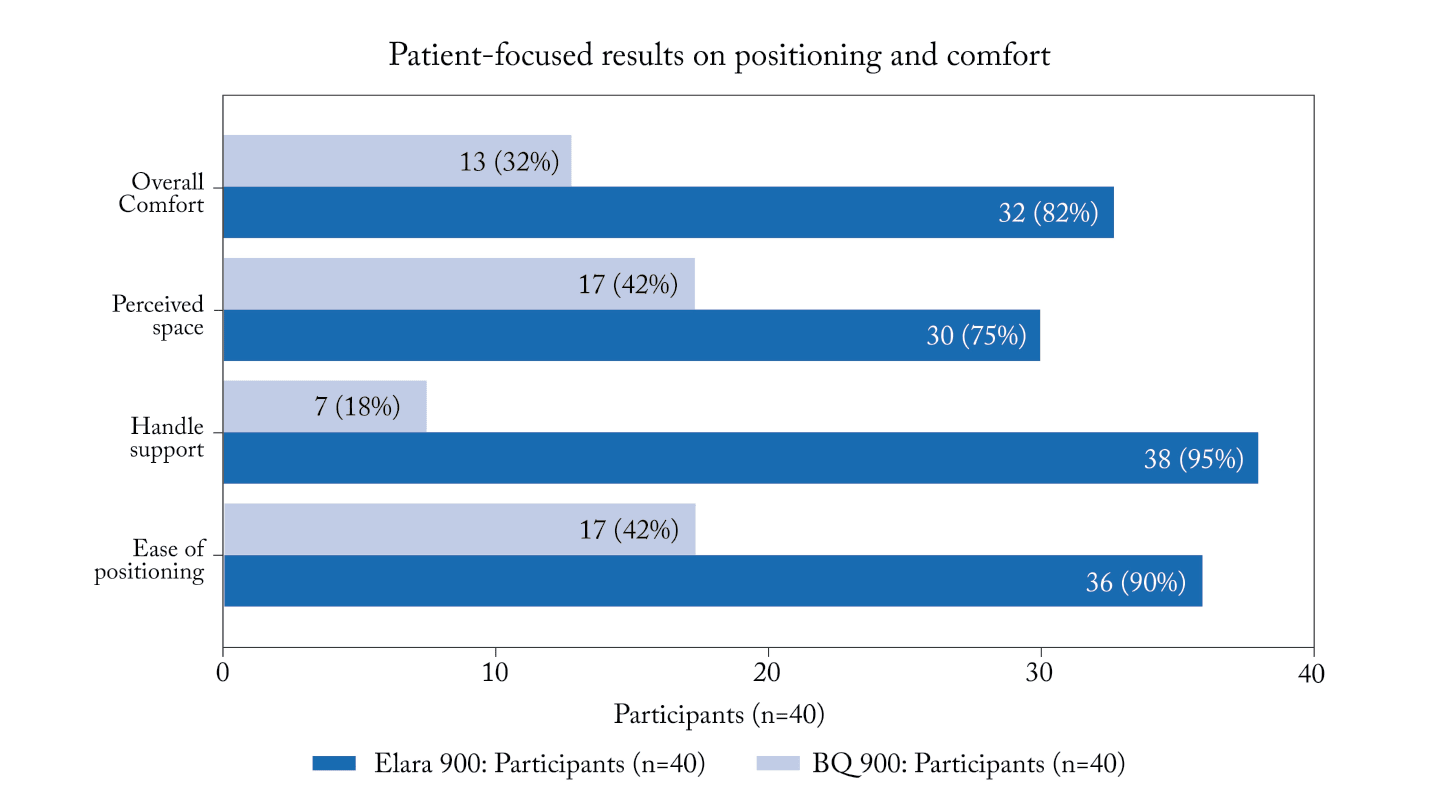
The ergonomics conversation often centers around the clinician, but patient positioning is central to slit lamp examination quality. If the patient is uncomfortable or poorly aligned, the examiner must compensate, which can increase strain on both sides of the instrument. The Elara 900 addresses this through a redesigned patient interface, including a more spacious headrest, comfortable chinrest and forehead band, and optional patient handles. The aim is to create room, reduce upper-body pressure, and make it easier for patients to settle into a stable position.
As Dr. McKee notes, “Most slit lamps in the past did not take into consideration the patient position. It was always a challenge to get the patient and the doctor properly aligned.” With the Elara 900, however, the forward-canted headrest gives patients more room behind the instrument, reducing the need to bend at the waist to place the chin and forehead correctly. Once the patient is sitting upright and looking straight ahead, Dr. McKee adds, “It’s much easier for me to address the patient without bending over as well.”
Less strain, smoother workflow
A more comfortable examination is not only about reducing discomfort; it can also reduce friction in the workflow. When controls are easier to reach, height adjustments are motorized, magnification can be changed without breaking focus, and “preset” examination scenarios are available at a touch, the clinician spends less time managing the instrument and more time attending to the examination.
For Dr. Preeya Gupta, cornea and cataract surgeon at Triangle Eye Consultants in North Carolina, this combination is fundamental to the overall experience. She highlights the ergonomic tabletop* that allows examiners to sit closer to the slit lamp without leaning forward, the angled oculars that help minimize neck strain, and the added space for clinicians working directly at the patient’s eye during procedures. “To me, that is super valuable,” she says. The same theme extends to digital “presets” and integrated imaging. Dr. Gupta describes the ability to save preferred settings and quickly switch examination modes as part of the improved experience. The value is not simply speed; it is consistency, reduced manual adjustment, and less interruption to the clinician’s posture and concentration.
Feeling better, seeing better
The Elara 900’s ergonomic design does not replace the fundamentals of slit lamp examination. Technique, training, positioning habits, and adaptation time still matter. But the device suggests a new direction for slit lamp design: one in which optical performance, workflow efficiency, examiner comfort, and patient experience are treated as connected parts of the same clinical encounter.
Part 1 of this series looked at what happens when illumination helps clinicians see differently. Part 2 asks what happens when the instrument itself helps clinicians work differently. The answer, from the early data and KOL experience, is that ergonomics is more than a comfort feature; it is a foundation for sustainable, efficient, patient-centered examinations – helping clinicians see more, work smarter, and feel better.*
*Reliance Ergonomic Tabletop available in the US only.
References
- Elara 900 white paper series – ergonomics.
- AS Kitzmann et al., “A survey study of musculoskeletal disorders among eye care physicians compared with family medicine physicians,” Ophthalmology, 119, 213-20 (2012). PMID: 21925736.
- SA Schechet et al., “Survey of musculoskeletal disorders among US ophthalmologists,” Digit J Ophthalmol., 26, 36 (2020). PMID: 33867881.
