The eye doctors pictured in Hogarth’s Southwark Fair (1733)
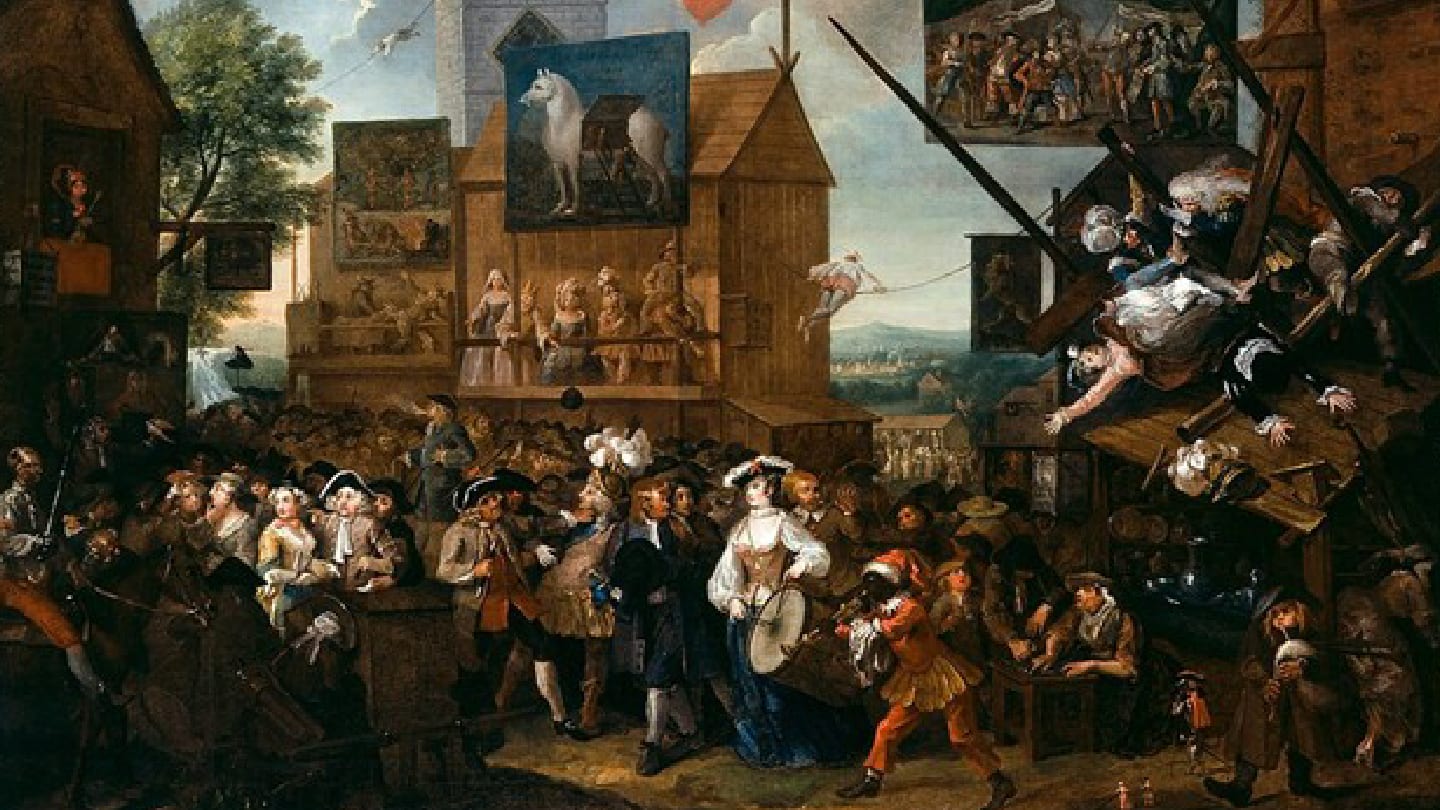
In the 1700s, itinerant surgeons and showmen shared many characteristics. William Hogarth’s 1733 painting of Southwark Fair, an annual event that was held in London, is reputed to picture not one, but two oculists (Figure 1) (1-3).
One was Richard Rock (c. 1690-1777). He is presumed to be the man standing somewhat elevated on a small stage, blowing a cloud of smoke, and attended by a mountebank holding a bottle, although others have thought the figure was an ordinary fire-eater (2). Rock was a physician from Hamburg, who advertised as early as 1726 as “the famous Oculist from St. Thomas’s Hospital-Gate, London,” and was known to couch cataracts, although he later focused on dentistry and then venereal disease (1-3). Hogarth included Rock in the painting A Harlot’s Progress, which depicted the final stages of venereal disease.
The other eye doctor reputed to be featured in Southwark Fair was Andreas Larini (also known as Signor Violante), an Italian oculist and rope slider married to a famous professional dancer, Signora Mariana Violante (1682-1741) (1). He performed acts of acrobatics and sliding down ropes. When he slid down a rope on May 31, 1727 from the steeple of St.Martin-in-the-Fields, Westminster, traveling 300 yards in 30 seconds, the royal princesses were in attendance. In July 1728, Violante flew from St. Vincent’s Rocks at Clifton across the River Severn, traveling 550 yards in half a minute, while firing a pistol held in each hand. Some scholars deem it likely that Signor Violante is indeed the acrobat seen sliding down the straight rope in the painting, and his wife the acrobat on the slack rope (1-3).
In the 1700s, itinerant surgeons and showmen shared many characteristics. William Hogarth’s 1733 painting of Southwark Fair, an annual event that was held in London, is reputed to picture not one, but two oculists (Figure 1) (1-3).
One was Richard Rock (c. 1690-1777). He is presumed to be the man standing somewhat elevated on a small stage, blowing a cloud of smoke, and attended by a mountebank holding a bottle, although others have thought the figure was an ordinary fire-eater (2). Rock was a physician from Hamburg, who advertised as early as 1726 as “the famous Oculist from St. Thomas’s Hospital-Gate, London,” and was known to couch cataracts, although he later focused on dentistry and then venereal disease (1-3). Hogarth included Rock in the painting A Harlot’s Progress, which depicted the final stages of venereal disease.
The other eye doctor reputed to be featured in Southwark Fair was Andreas Larini (also known as Signor Violante), an Italian oculist and rope slider married to a famous professional dancer, Signora Mariana Violante (1682-1741) (1). He performed acts of acrobatics and sliding down ropes. When he slid down a rope on May 31, 1727 from the steeple of St.Martin-in-the-Fields, Westminster, traveling 300 yards in 30 seconds, the royal princesses were in attendance. In July 1728, Violante flew from St. Vincent’s Rocks at Clifton across the River Severn, traveling 550 yards in half a minute, while firing a pistol held in each hand. Some scholars deem it likely that Signor Violante is indeed the acrobat seen sliding down the straight rope in the painting, and his wife the acrobat on the slack rope (1-3).
A century later, on May 27, 1826, English newspaper The Bristol Mercury reported
that Violante accidentally hanged himself while performing, leading his biographers to consider that he might have died in such a manner somewhere near Bristol. However, recent research indicates that he survived his late 1720s period of daring acrobatics (1-3). By 1731, Madame Violante was 49 years old, and perhaps the Signor was of a similar age, and wanted a less adventuresome career. In Dublin, where his wife was dancing, Larini advertised on May 17, 1731:
“Andreas Laurini, by Birth an Italian, a long Practicer in all Branches of Physick Chymistry, and a Profess’d Occulist…Any Distemper incident to the Eyes…Ruptures…Wens…King’s Evil…Ulcer or Canker, the Fistula, Falling Sickness…Scurvy…Draws Teeth” (3).
“Mr. Larini” played a servant in a play put on by “Signora Violante” in Newcastle in June 1735 (3). In 1735, the Signora opened a dancing school in Edinburgh, where she remained until her death in 1741 (1,3). Records place her husband remaining in Edinburgh in 1744, although his date of death is unknown (1).
Hogarth’s paintings provided satirical commentary on moral decay. The Southwark Fair was abolished in 1762 because the authorities believed it caused vice and disturbances. Hogarth depicted these ophthalmic healers in a social and moral borderland—operating at the margins of respectable society, and at the outer edge of what the authorities were willing to tolerate.
that Violante accidentally hanged himself while performing, leading his biographers to consider that he might have died in such a manner somewhere near Bristol. However, recent research indicates that he survived his late 1720s period of daring acrobatics (1-3). By 1731, Madame Violante was 49 years old, and perhaps the Signor was of a similar age, and wanted a less adventuresome career. In Dublin, where his wife was dancing, Larini advertised on May 17, 1731:
“Andreas Laurini, by Birth an Italian, a long Practicer in all Branches of Physick Chymistry, and a Profess’d Occulist…Any Distemper incident to the Eyes…Ruptures…Wens…King’s Evil…Ulcer or Canker, the Fistula, Falling Sickness…Scurvy…Draws Teeth” (3).
“Mr. Larini” played a servant in a play put on by “Signora Violante” in Newcastle in June 1735 (3). In 1735, the Signora opened a dancing school in Edinburgh, where she remained until her death in 1741 (1,3). Records place her husband remaining in Edinburgh in 1744, although his date of death is unknown (1).
Hogarth’s paintings provided satirical commentary on moral decay. The Southwark Fair was abolished in 1762 because the authorities believed it caused vice and disturbances. Hogarth depicted these ophthalmic healers in a social and moral borderland—operating at the margins of respectable society, and at the outer edge of what the authorities were willing to tolerate.
References
- MC Barbieri, “Signora/Madame Violante: una ‘high-flyer’di successo tra Londra, Dublino ed Edimburgo,” in F Cotticelli et al. (eds.), Amministrare, gestire, allestire lo spettacolo nel XVII e XVIII secolo: Economy, Management and Staging of Performances in the 17th and 18th Centuries, 275, Edizioni di Pagina: 2025.
- W Trusler, “Hogarth Moralized; a complete edition of all the most capital and admired works of William Hogarth, accompanied with concise and comprehensive explanations of their moral tendency,” 253, Shakespeare Press for John Major: 1831.
- CT Leffler, SG Schwartz, “A Chronology of Oculists and Cataract Surgeons in the British Isles (Antiquity to 1800),” in CT Leffler (ed), Biographies of Ophthalmologists from Around the World: Ancient, Medieval, and Early Modern, 89, Commonwealth Academic Press: 2024.