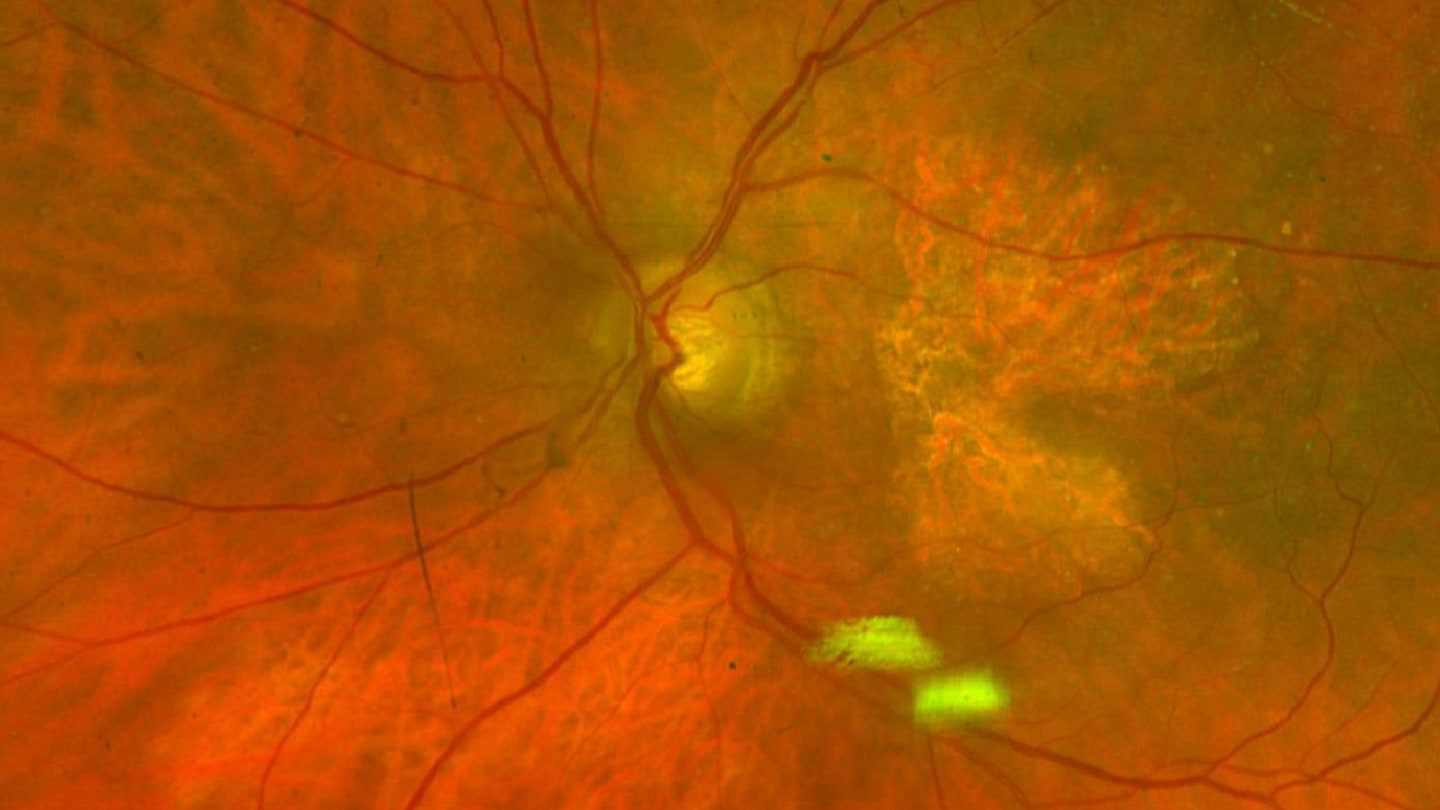
For retina specialists managing geographic atrophy (GA), the treatment landscape has changed rapidly. Complement inhibitors have brought the first approved options for slowing lesion growth, while other approaches – including ocular gene therapies – remain in development. But approval does not automatically settle the clinical question. In practice, specialists must weigh structural benefit, safety risks, injection burden, lesion location, visual acuity, and the patient’s remaining visual reserve.
A new study published in Clinical Ophthalmology offers what the authors describe as the “first quantitative assessment of retina specialists’ (RS) preferences for GA treatment.” Using a best-best discrete choice experiment, the researchers asked 166 US-based retina specialists to choose between hypothetical GA treatment options – or no treatment – across a series of patient profiles. All participants had at least seven years of clinical experience and had managed at least 50 patients with GA in the previous year; most had already prescribed pegcetacoplan or avacincaptad pegol.
The survey tested how specialists valued five key treatment characteristics: reduction in GA lesion growth rate, risk of mild-to-moderate intraocular inflammation, risk of progression to wet age-related macular degeneration (AMD), risk of retinal vasculitis, and frequency of intravitreal injections. The patient profiles varied by lesion location – foveal-threatening, non-foveal-threatening, or extrafoveal – and visual acuity in the fellow eye.
The clearest finding was that efficacy dominated decision-making. Across patient profiles, improving lesion growth rate reduction from 10 percent to 50 percent had the greatest influence on treatment choice, accounting for around 41 to 52 percent of decision-making depending on the clinical scenario. This effect was strongest when specialists considered patients with foveal-threatening lesions and poor vision in the other eye, suggesting that urgency and vulnerability shape the perceived value of treatment.
Of course, safety still mattered, but not all risks carried the same weight. Among the risks tested, progression to wet AMD was the most influential, contributing roughly 18 to 22 percent of treatment decision-making. Mild-to-moderate uveitis and retinal vasculitis were also relevant, though less influential over the ranges tested. Interestingly, specialists were more risk-averse when considering patients with extrafoveal or non-foveal-threatening lesions and good vision in the fellow eye, and more willing to tolerate risk when lesions threatened the fovea.
Intravitreal injection frequency had the smallest overall impact. Although specialists generally preferred a one-time injection – framed in the survey as gene therapy – over monthly treatment when efficacy was comparable, reduced treatment burden did not outweigh the need for meaningful lesion growth reduction. In other words, convenience was valued, but only after efficacy and safety thresholds were met.
The study also found broad openness to gene therapy: 80 percent of respondents said they would be willing to offer it to patients with GA. However, the study authors caution that this willingness depends on whether future therapies can deliver lesion growth reductions comparable to, or better than, current options while maintaining an acceptable safety profile.
The findings formalize what many treatment discussions already suggest: GA decision-making is deeply context-dependent. A patient with foveal-threatening disease and poor fellow-eye vision may justify a different benefit-risk calculation from someone with extrafoveal lesions and preserved binocular function.
As more GA therapies emerge, understanding how retina specialists interpret benefit, risk, and burden will be increasingly important. This study suggests that, for now, slowing lesion growth remains the central driver – but the acceptable price of that benefit changes with the eye in front of the clinician.
