“Macula” is short for “macula lutea”, or “yellow spot” in Latin (1). This does not seem to make sense, because the macula in the healthy, living eye does not appear yellow, although some macular diseases may have visible yellow or vitelliform pigment (“vitellus” means “yolk” in Latin).
The word “macula,” meaning “spot,” has been used in both medical and non-medical contexts in English for at least 500 years. For example, “macula” is the root word of “immaculate,” meaning “spotless.” “Macula” has been used extensively to describe flat lesions, especially on the skin. Interestingly, the Oxford English Dictionary contains a quote from around 1400, describing an ocular surface lesion (cyst) then called a wem: “Macula is a wem in a mannys iȝe.” (2) “Macula” is still used to describe some corneal lesions today. Arthur Groenouw described “type II corneal dystrophy” in 1890 (3). Max Bücklers used the phrase “dystrophia corneae macularis [Groenouw II]” in 1938, and this book was reviewed in an English language publication in 1939 using the term “macular corneal dystrophy” (4).
Before the invention of the ophthalmoscope by Hermann von Helmholtz in 1850, the only way to visualize the central retina was to section an enucleated eye. Using this technique, Francesco Buzzi described a yellow color in 1782 (Figure 1), although he did not use the word “macula” (5). Buzzi wrote, “… laterale al nervo ottico … si vede sempre la medesima retina tinta di un color giallo … [lateral to the optic nerve … is always seen the same retinal tint of a yellow color]” (6). Samuel Thomas von Sömmerring called this finding the “macula lutea” in 1799 (7). In 1818, James Wardrop wrote: “… there is a peculiar part of its structure called the Macula Lutea, discovered by Sömmerring, which has hitherto been only observed in the human eye, and the functions of which have not been even conjectured” (8).

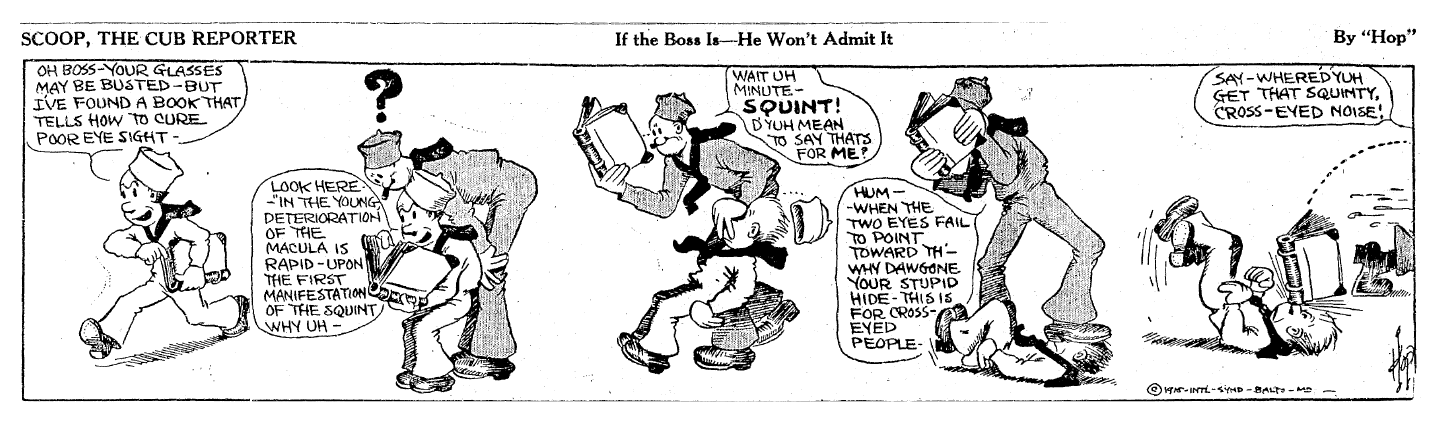
And a 1915 newspaper cartoon (Figure 2) used the word “macula” when describing the eye, suggesting that the average US newspaper reader of that time was familiar with the word (9).
References
- SG Schwartz, CT Leffler, "Uses of the word “macula” in written English, 1400-present," Surv Ophthalmol., 59, 659 (2014). Oxford English Dictionary, macula, n. meanings, etymology and more | Oxford English Dictionary accessed 11/18/25.
- A. Groenouw, "Knötchenförmige hornhauttrübungen (noduli corneae)," Arch Augenheilkunde, 21, 281 (1890).
- E Waldstein, "Die erblichen Hornhautdystrophien. Dystrophiae corneae hereditarie," Arch Ophthalmol., 21, 899 (1939).
- J Hirschberg (translated by FC Blodi FC), The History of Ophthalmology, 247, JP Wayenborgh: 1982
- F Buzzi, Opuscoli scelti sulle scienze e sulle arti tomo V, 95, Giuseppe Marelli: 1782.
- ST Sommerring , De foraminae centrali limbo lvteo cincto retinae hvmanae. Commentationes Societatis Regiae Scientarium Gottingensis, Vol. 13, 13, Joann Christian Dieterich: 1799.
- J Wardrop, Essays on the Morbid Anatomy of the Human Eye, 2nd Edition, 135, George Ramsay: 1818.
- “Hop," Scoop, The Cub Reporter: If the Boss Is-He Won’t Admit It (cartoon). Trenton Evening Times 10/3/1915, no volume listed:12. Available from http://infoweb.newsbank.com accessed 11/19/25.
