Conexiant
Login
  • Corneal Physician
  • Glaucoma Physician
  • New Retinal Physician
  • Ophthalmology Management
  • Ophthalmic Professional
  • Presbyopia Physician
  • Retinal Physician
The Ophthalmologist
  • Explore

    Explore

    • Latest
    • Insights
    • Case Studies
    • Opinion & Personal Narratives
    • Research & Innovations
    • Product Profiles

    Featured Topics

    • Anterior Segment
    • Glaucoma
    • Retina

    Issues

    • Latest Issue
    • Archive
  • Subspecialties
    • Cataract
    • Cornea
    • Glaucoma
    • Neuro-ophthalmology
    • Oculoplastics
    • Optometry
    • Pediatric
    • Retina
  • Business

    Business & Profession

    • Professional Development
    • Business and Entrepreneurship
    • Practice Management
    • Health Economics & Policy
  • Training & Education

    Career Development

    • Professional Development
    • Career Pathways

    Events

    • Webinars
    • Live Events
  • Events
    • Live Events
    • Webinars
  • Community

    People & Profiles

    • Power List
    • Voices in the Community
    • Authors & Contributors
  • Multimedia
    • Video
Subscribe
Subscribe

False

Advertisement
The Ophthalmologist / Issues / 2026 / February / The Ophthalmologist’s Time Machine 38
Discussion

The Ophthalmologist’s Time Machine 38

Glaucoma, eugenics, and Lucien Howe (1848-1928): when the personal became political

By Christopher T. Leffler, Stephen G. Schwartz, Andrzej Grzybowski 2/27/2026 0 min read

Share


It is generally known that prominent ophthalmologist Lucien Howe of Buffalo, New York eventually came to promote eugenics in the early 20th century (1, 2) as did many American physicians and scientists of the pre-World War II period (1, 3). What is perhaps less well-known is how his personal circumstances may have contributed to this stance.

In 1887, Howe published the case series of a family suffering from multiple cases of "hereditary glaucoma"across three generations (Figure 1) (3). In that era, “glaucoma” typically referred to what we would term today as “angle-closure glaucoma” (2, 4). We now understand that plateau iris is one type of angle-closure glaucoma which can have a strong heritable component (2).
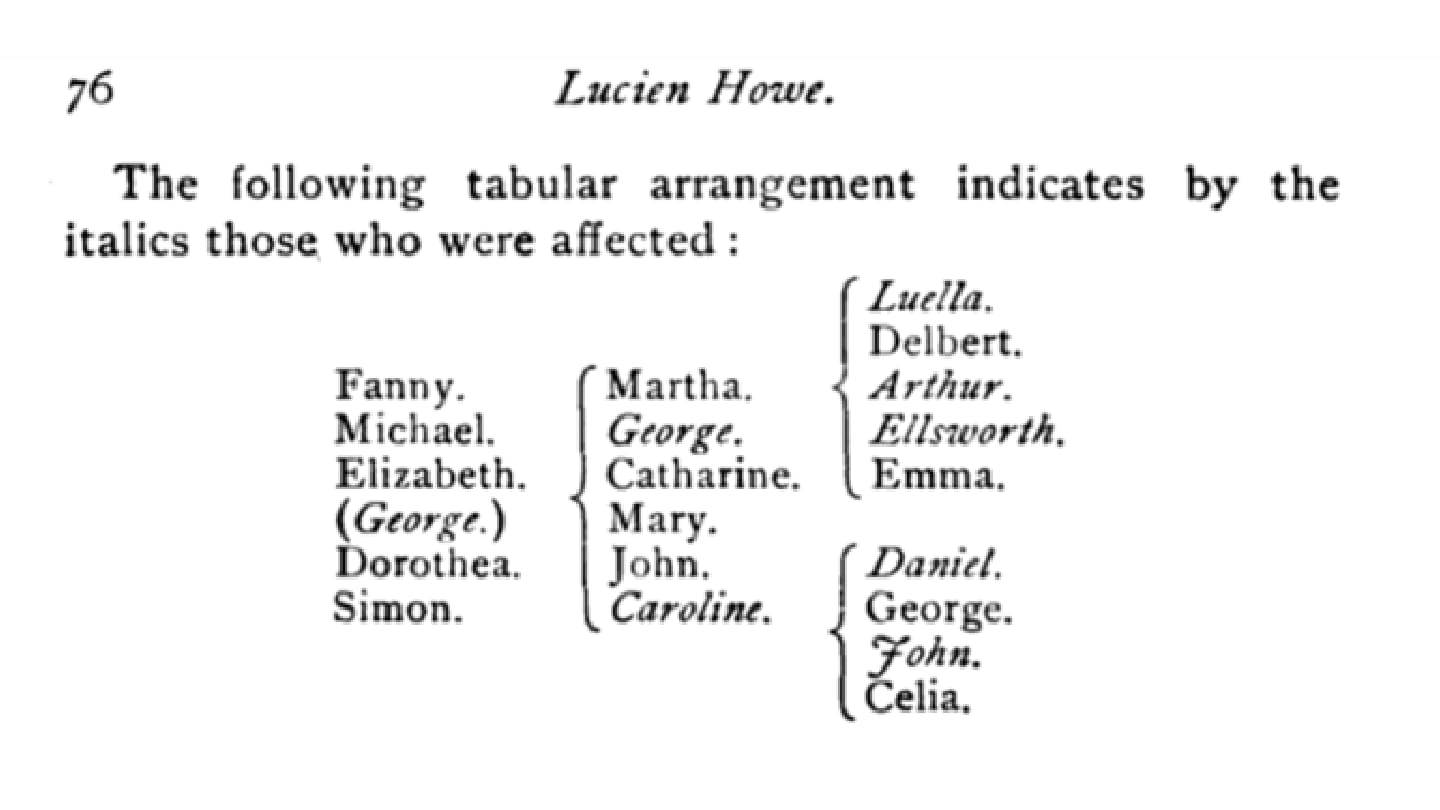
Figure 1. Pedigree of a family with glaucoma, from Howe’s 1887 report ("A Family History of Blindness from Glaucoma," Arch. Ophthalmol. 16: 72 [1887])

Iridectomy as a treatment for “glaucoma” was reported by Albrecht von Graefe in 1857 (4). An iridectomy (or iridotomy) can be effective.  However, as we see even today, the procedure does not provide a permanent cure in all cases of angle-closure glaucoma (5). In fact, long-term follow-up of the cases which Graefe originally described shows that some continued to progress and develop blindness (4). Thus, “glaucoma” was became a much feared disease in the 19th century (2).

In 1893, the 45-year-old Howe married his 33-year-old first cousin (2). What has not been generally known until recently is that, according to a colleague, in Howe’s family “glaucoma appeared in each generation of his own pedigree" (2). Given that Howe had established the heritable nature of this disorder, he had reason to fear it would develop in any children from his marriage.

In 1918, Howe wrote “It is unjust to the blind to allow them to be brought into existence simply to lead miserable lives… It is unjust to the taxpayers to be compelled to support them… this misery and expense could be gradually eradicated by sequestration or by sterilization" (2). Howe noted that one could trace “serious eye defects” when “first cousins of such crossings marry" (2). He also noted that “when two persons contemplate matrimony, it can usually be taken for granted that their judgment has, for the time, taken wing" (2). Howe mentioned that his wife worked in his office. An ophthalmologist who worked at the School for the Blind in Howe’s home city of Buffalo spoke up in the discussion to say he knew of more than one “family of cousins” in Buffalo costing the New York taxpayer.

By 1923, Howe even considered that for couples contemplating marriages deemed dangerous, the state shcould impose sterilization, imprisonment, or requirement of a bond to cover the cost of raising children afflicted by hereditary blindness (1, 2).

Howe and his wife never had children (1, 2).

References

  1. JG Ravin et al., "Howe, hereditary blindness, and the eugenics movement," Archives of Ophthalmology, 128, 924 (2010).
  2. CT Leffler, S Bansal, "Angle-closure glaucoma since 1871," in CT Leffler (ed.), The History of Glaucoma, 309, Wayenborgh: 2020.
  3. SG Schwartz, CT  Leffler, "Uses of the word 'macula' in written English, 1400–present," Survey of Ophthalmology, 59, 649 (2014).
  4. CT Leffler, "Glaucoma: a pressure-induced optic neuropathy (1850-1870)," in CT Leffler (ed.) The History of Glaucoma, 263. 2020.
  5. A Azuara-Blanco et al., "Effectiveness of early lens extraction for the treatment of primary angle-closure glaucoma (EAGLE): a randomized controlled trial," Lancet, 388(10052):1389 (2016).

About the Author(s)

Christopher T. Leffler

Associate Professor, Department of Ophthalmology, Virginia Commonwealth University and Richmond VA Medical Center, Richmond, Virginia, USA. His book on the history of ophthalmology can be found here: https://kugler.pub/editors/christopher-t-leffler/

More Articles by Christopher T. Leffler

Stephen G. Schwartz

Professor of Clinical Ophthalmology, Bascom Palmer Eye Institute, University of Miami Miller School of Medicine, Naples, FL, USA

More Articles by Stephen G. Schwartz

Andrzej Grzybowski

Andrzej Grzybowski is a professor of ophthalmology at the University of Warmia and Mazury, Olsztyn, Poland, and the Head of Institute for Research in Ophthalmology at the Foundation for Ophthalmology Development, Poznan, Poland. He is EVER Past-President, Treasurer of the European Academy of Ophthalmology, and a member of the Academia Europea. He is co-founder and leader of the International AI in Ophthalmology Society (https://iaisoc.com/) and has written a book on the subject that can be found here: https://link.springer.com/book/10.1007/978-3-030-78601-4.

More Articles by Andrzej Grzybowski

Related Content

Newsletters

Receive the latest Ophthalmology news, personalities, education, and career development – weekly to your inbox.

Newsletter Signup Image

False

Advertisement

False

Advertisement

Explore More in Ophthalmology

Dive deeper into the world of Ophthalmology. Explore the latest articles, case studies, expert insights, and groundbreaking research.

False

Advertisement
The Ophthalmologist
Subscribe

About

  • About Us
  • Work at Conexiant Europe
  • Terms and Conditions
  • Privacy Policy
  • Advertise With Us
  • Contact Us

Copyright © 2025 Texere Publishing Limited (trading as Conexiant), with registered number 08113419 whose registered office is at Booths No. 1, Booths Park, Chelford Road, Knutsford, England, WA16 8GS.

Disclaimer

The Ophthalmologist website is intended solely for the eyes of healthcare professionals. Please confirm below: