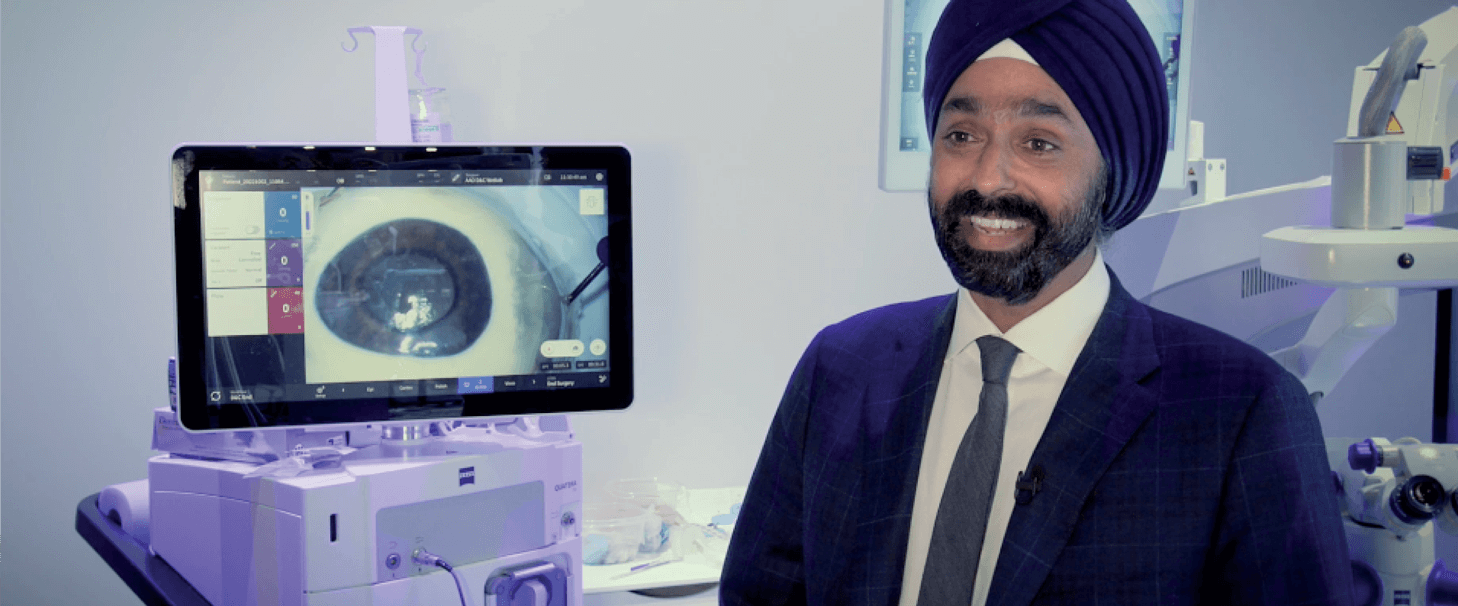
Paul Singh, President of The Eye Centers of Racine & Kenosha, Wisconsin, USA, is an anterior segment and glaucoma surgeon who performs a lot of cataract procedures combined with MIGS. He is also a musician and a proud Wisconsin cheesehead – a fan of the Green Bay Packers. At AAO 2022 in Chicago, Illinois, he shared his experience with the new QUATERA 700 cataract surgery platform from Carl Zeiss.
Singh pinpoints the QUATERA 700’s ease of use as one of its biggest advantages. The reason for this is, he says, that a lot of surgeons are used to certain phaco environments. “After all, surgeons love consistency. Surgical routine is about muscle memory, visually and physically. Changing environments can be hard!”
Happily though, the QUATERA 700 has some unique characteristics – Singh explains that, because the QUATERA 700 allows surgeons to independently control both fluid and vacuum, they can create any environment they want without having to compromise. A surgeon used to one type of environment can transition slowly to another by tweaking parameters individually. This results in a machine that is efficient and easy to use.
It isn’t just in its design that the QUATERA 700 stands out, but also in the confidence it gives surgeons to handle complex cases. Singh appreciates the QUATERA 700 for its ability to maintain a highly stable chamber, which is a vital part of the fluidics in any phaco machine. He comments that surgeons must make sure they have a rock-solid environment; chamber pressure fluctuation increases the risk of iris prolapse or postoperative corneal edema.
Some machines have great chamber stability – but, Singh points out, that can come with downsides. To keep that stability, the surgeon may have to increase the infusion to prevent post-occlusion surge and fluctuation in the chambers. In contrast, Singh emphasizes that the QUATERA 700’s independent control of fluidics means it can respond to situations in real time – and that it facilitates lower overall fluid use while maintaining a stable chamber pressure, even with vacuum levels of around 700. It is this focus on chamber stability that Singh highlights as the biggest benefit of the new system.
Yet the stability offered hasn’t sacrificed high-vacuum potential. Singh explains that, if the vacuum isn’t high enough, surgeons may have to go under the capsule – even all the way to the equator – to remove cortical material. The QUATERA 700 system makes it easy to stay at the edge of the anterior capsule because its powerful vacuum brings cortical pieces to the surgeon. The advantage of this, Singh points out, is that the risk of corneal edema is minimized.
All of these design innovations make the surgical process more efficient and more comfortable for everyone in direct patient care. “One of the things I love about surgery is that everybody is on the same page,” says Singh. “The OR is like a ballet. There are many different parts happening at once, but it should feel seamless. If each person only sees one thing, they’re all working in isolation.” The solution? For Singh and team, it’s using the ARTEVO 800 microscope’s 3D heads-up display to ensure that everybody in the OR sees the same details the surgeon is seeing. Singh points out that, in other machines that aren’t 3D, staff lose depth of view if they aren’t perfectly in line with the display. With the ARTEVO 800, everyone gets a clear view of what is going on at all times.
This technological refinement makes a difference to not just the operating surgeon, but the whole surgical team. Singh says, “My main technician, who has worked with me for years, told me, ‘Now that I can see exactly what you’re seeing, I’m much more proactive.’” It’s clear that using the QUATERA 700 system with the ARTEVO 800 can help surgical teams become more efficient – and more effective.
This allows for a truly integrated and optimized workflow. “I love integration,” says Singh. “The more we can integrate technology and decrease guesswork, the better.” Here, he mentions the CALLISTO eye computer, a digital system that allows surgeons to align toric lenses or center multifocal lenses on the visual axis. This alignment is based on preoperative measurements from the IOLMaster 700 SWEPT Source OCT, which can then be transferred into the CALLISTO so that surgeons can reference the eye during surgery and know exactly where the axis are and where the center of the visual axis is. Integrating that with the QUATERA 700 means that surgeons just need to use the foot pedal to bring up different screens, making the workflow faster and more comfortable. After all, Singh says, “Not every change is revolutionary, but they’re all evolutions.”
But what is the system like for hands-on users? “The first day I used the QUATERA 700 with the ARTEVO 800 and the CALLISTO eye computer, I was floored,” says Singh. “I could see all my QUATERA 700 parameters on my 3D heads-up scope. I love 3D heads-up because I had neck surgery many years ago, so if I’m pushed too far with the microscope or oculars, I get headaches. Now, I can relax and do MIGS without worrying about being stuck at the microscope level.”
In a field that changes as rapidly as ophthalmology, it’s important for surgeons to be open to learning – and, for Singh, this is an unexpected bonus of the QUATERA 700 system. “As I change from a fluidic base to a vacuum base, I can see all the parameters live.” During a busy workday, it’s often difficult to go back and look at parameters after surgery, but real-time access to that information offers surgeons greater awareness of their techniques. Singh says it’s the QUATERA 700’s easy-to-use design that facilitates these insights. “The graphic user interface is very intuitive. I think that, within the first day, you should feel comfortable knowing where to look.”
Singh also highlights another feature that makes the system unique – the rescan, a live OCT function that can be used in multiple ways. Singh, a self-professed glaucoma geek, thinks it’s “wonderful to be able to see structures that we couldn’t before.”
Surgeons are beginning to appreciate the benefits of intraoperative OCT in the glaucoma world, as well as for corneal and retinal procedures. Singh believes the technique will allow glaucoma specialists to better understand what they’re doing with various MIGS devices – and that the Carl Zeiss QUATERA 700 system is the tool to give them that knowledge. His overall impression? “I love it!”