Ocular Surface Control in Surgical Dry Eye
Real-world experience with Lacrifill® Canalicular Gel
Exploring the use of Lacrifill® to support ocular surface control in patients with moderate-to-severe DED before and following ocular surgery
For patients undergoing cataract or refractive surgery, controlling the ocular surface is an important part of the surgical journey. An unstable ocular surface can compromise pre-operative measurements and surgical planning, while dry eye disease may remain a challenge following ocular surgery.1-6
In this educational collection, clinicians from the UK, Germany and Portugal share their real-world experience of using Lacrifill® Canalicular Gel, a cross-linked hyaluronic acid gel administered into the canaliculus, in patients with moderate-to-severe DED across different surgical settings.
Johnson Neo discusses patients with moderate-to-severe DED undergoing cataract surgery or LASIK. Following pre-operative Lacrifill® administration, statistically significant improvements were observed in tear meniscus height, Schirmer's score, tear film break-up time, corneal staining and patient-reported symptoms. Improvements in tear film parameters were sustained at four weeks post-operatively.
Elias Golschan illustrates the importance of achieving ocular surface control before cataract surgery. His patient, who had advanced DED and suspected Sjögren's syndrome, had previously had surgery postponed because ocular surface instability prevented reliable biometry. Following Lacrifill® treatment, symptoms and objective ocular surface findings improved, enabling reproducible pre-operative measurements and surgical planning to proceed.
Joana Pargana and colleagues explore another challenge within the surgical dry eye journey: persistent DED in a patient with a history of LASIK and pterygium surgery. Despite extensive previous therapy, the patient remained highly symptomatic. One month after Lacrifill® administration, patient-reported symptoms and reliance on tear supplements were reduced, alongside improvements in tear meniscus height and ocular surface staining.
Together, these real-world experiences highlight the importance of ocular surface control across the surgical journey and illustrate the potential role of Lacrifill® in managing moderate-to-severe DED in patients undergoing, or with a history of, ocular surgery.
For more information on Lacrifill visit Lacrifill.info
GL-LAC-2600067 | September 2026
References
1. Epitropoulos AT, et al. J Cataract Refract Surg. 2015 Aug;41(8):1672–1677.
2. Röggla V, et al. Am J Ophthalmol. 2021 Jan:221:1–8.
3. Starr CE, et al. J Cataract Refract Surg. 2019 May;45(5):669–684.
4. Kojima T, et al. J Refract Surg. 2011 Dec;27(12):894–898.
5. Kim J, et al. BMC Ophthalmol. 2021 Oct 13;21(1):364.
6. Trattler WB, et al. Clin Ophthalmol. 2017 Aug;11:1423–1430.
Case Study: Lacrimal Occlusion for Preoperative Ocular Surface Optimization
A real-world case study exploring the use of Lacrifill for lacrimal occlusion in patients with moderate-to-severe dry eye ahead of cataract or refractive surgery
DownloadCase Study: Preoperative Ocular Surface Optimization in Cataract Surgery
A case study exploring the use of Lacrifill in a patient with severe dry eye disease prior to cataract surgery
DownloadCase Study: Managing Refractory Dry Eye in a Patient With a History of Ocular Surgery
A case study exploring the use of Lacrifill® in a patient with severe, treatment-refractory dry eye disease and a history of LASIK and pterygium surgery
DownloadLacrimal Occlusion with Cross-Linked Hyaluronic Acid Canalicular Gel to Optimize the Ocular Surface
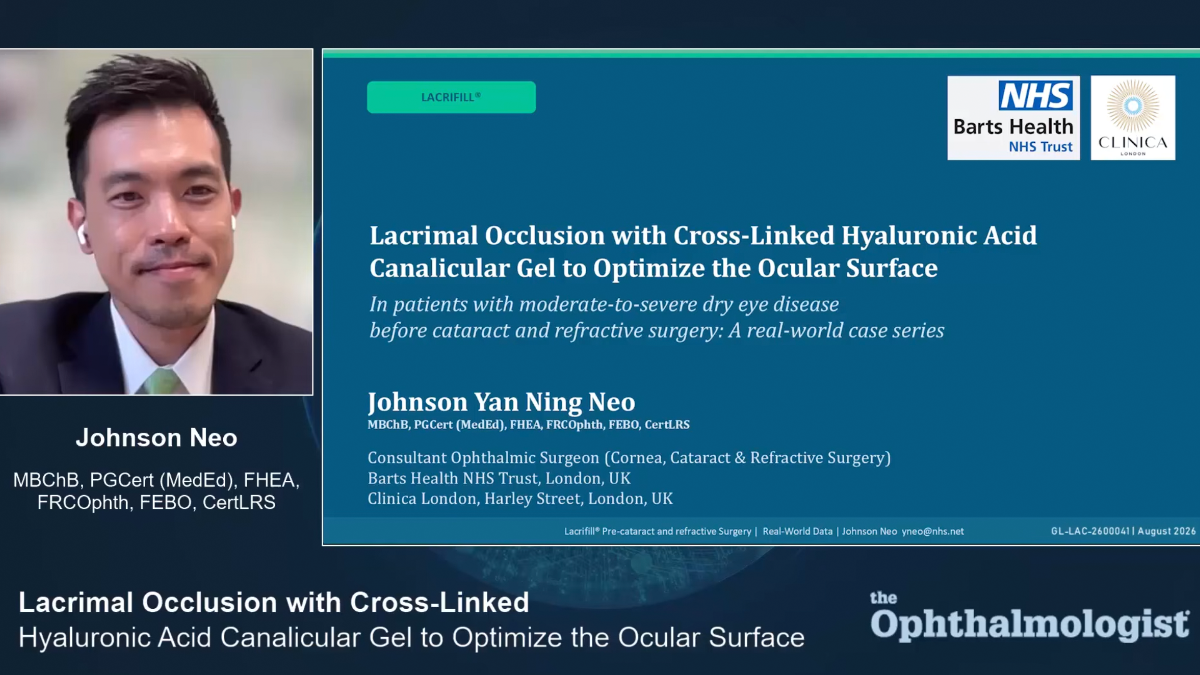
In this video, Johnson Neo presents a real-world case series of patients with moderate-to-severe DED undergoing cataract surgery or LASIK.
Watch Now