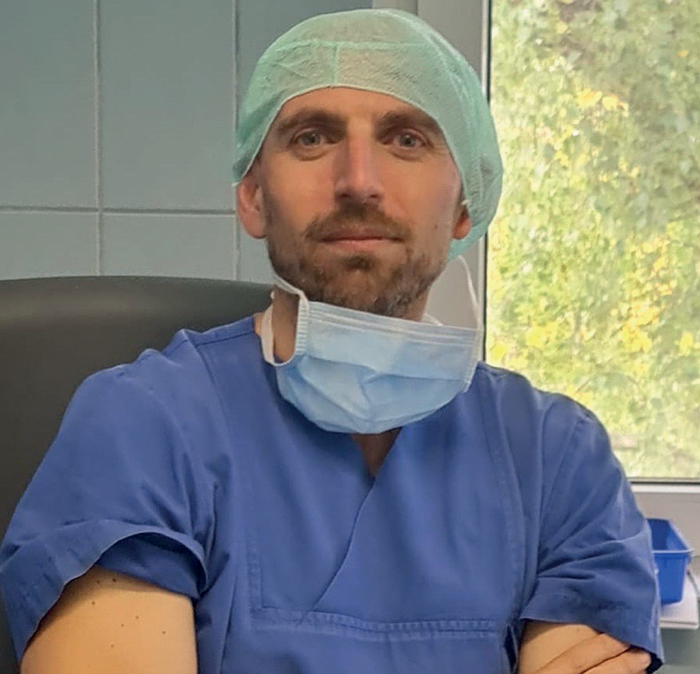
A patient’s view of a medical procedure comes from a different vantage point to that of a clinician. Although both share the same destination – better or stable vision – the notable landmarks along the journey vary considerably. Dr Karl Mercieca, the Director of Glaucoma Services at the University Hospital Bonn Eye Clinic, Germany, has been acutely aware of these differing points of view in his efforts to assess the patient experience of outcomes with the OMNI surgical system. “Imagine that you offer a surgical procedure to a patient, but the procedure takes an hour, is uncomfortable, and significantly reduces their vision the next day,” he says. “Even though you may have achieved an amazing eye pressure outcome and did everything perfectly from your point of view, what about the patient perspective? Most patients will not know the specific anatomy and physiology of the eye, but I still think it’s imperative to engage our patients in the procedures we are performing on them.”
From Dr Mercieca’s perspective, the OMNI surgical system offers several benefits that cater to the perspective of both the clinician and the patient. Like many MIGS procedures, the OMNI procedure is both time and technically efficient and can be performed under local anesthetic. Moreover, the post-operative recovery is swift from day one due to the minimally invasive nature of the procedure. Additionally, as the process does not require stitches, patients do not experience the “gritty foreign body” feeling often reported with other glaucoma procedures and there is no need for anti-metabolite injections or other manipulations such as bleb massage. Further along the postoperative pathway, clinicians who perform an OMNI procedure generally do not have to see patients as often as traditional glaucoma surgeries and, depending on local practices, patients may be quickly discharged to the community ophthalmologist or optometrist colleagues, keeping availability at the tertiary referral university hospitals open for the more complex glaucoma cases that might clearly benefit more from seeing a glaucoma subspecialist as soon as possible.
While the OMNI procedure offers a straightforward surgical approach comparable to that of placing trabecular bypass stents, as well as the ability to treat a similar patient cohort, Dr Mercieca encourages surgeons to leverage the key beneficial differentiators over stent devices. Specifically, he highlights the opportunity to restore or rejuvenate natural outflow channels, rather than simply bypassing them.
Certainly, all the above important factors expressed by Dr Mercieca contribute to his positive experience of the OMNI procedure, but there is another aspect that he credits as being crucial to improving his experience with the OMNI system: Being conscientious with patient selection. “I take into account not only what type of glaucoma a patient has, but also their age, their personality, their fears, and other factors that could impact their experience,” he explains. “This is something that I try to judge beforehand; but, of course, we can’t always be right – a patient may be anxious in the clinic, but incredibly calm in the operating room (and vice versa!) – but doing our part is a really positive step towards ensuring that patients have a good experience.”
Dr Mercieca’s patient selection process also considers the important issue of the lens status – whether the patient is phakic or pseudophakic, or if they have significant cataract. By taking a non-linear approach to his surgical thought-processes, he can deal with multiple issues at once. Where a glaucoma patient presents with a significant cataract, they can be offered a ‘once-in-a-lifetime’ approach to simultaneously improve their vision while concurrently treating their glaucoma, potentially reducing their medication burden. This was not the case 10 years ago before the introduction of MIGS changed the glaucoma treatment landscape. Such tailored treatment avenues are attractive to both surgeons and patients – helping align goals for both best experience and outcome.
IMPORTANT PRODUCT INFORMATION:
INDICATIONS FOR USE: The OMNI® Surgical System is indicated for the catheterization and transluminal viscodilation of Schlemm’s canal and the cutting of trabecular meshwork to reduce intraocular pressure in adult patients with open-angle glaucoma. For important safety information including contraindications, warnings, precautions and adverse events, please visit omnisurgical.com
Dr Mercieca is a paid consultant of Sight Sciences, Inc
Disclaimer
This information is intended solely for the use of ophthalmic clinicians - Patients should contact their eyecare professional.
© 2023 Sight Sciences, Inc 7/23 OM-2987-OUS.v1 CE2797
OMNI and the Sight Sciences logo are registered trademarks of Sight Sciences, Inc.
